
 Canada
 USA
USA Japan
Japan



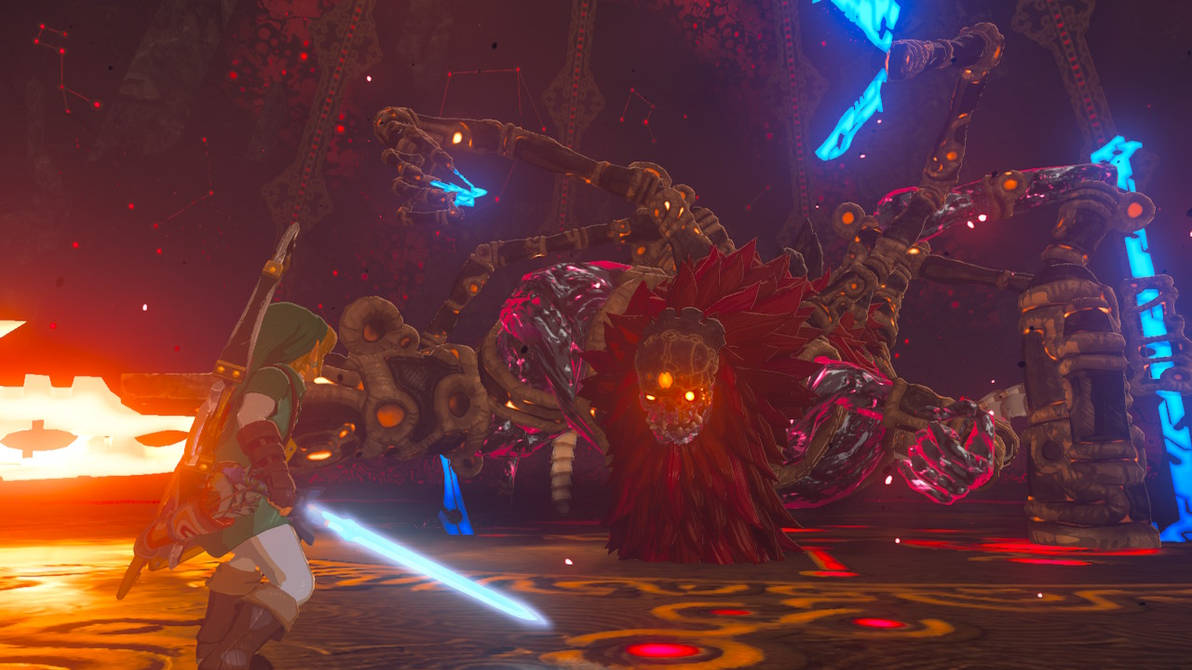
There is a specific kind of dread that “Breath of the Wild” creates around Calamity Ganon that is unlike anything else in the Zelda franchise’s long history of memorable villains. You feel it the moment you emerge from the Shrine of Resurrection and see Hyrule Castle for the first time, that massive fortress wrapped in swirling dark energy, the malevolent presence that has been sitting there for a hundred years, accumulating power, waiting. You feel it in the ruined landscapes of Hyrule, in the silent Divine Beasts, in the Guardian machines that hunt you across the plains with patient, relentless precision. You feel it in the grief of the people who survived the Great Calamity and who speak about what happened with the specific weight of people who watched their world end and somehow kept living.
Calamity Ganon is not a villain in the conventional Zelda sense. He is not the scheming Ganondorf of “Ocarina of Time,” plotting in the shadows of the Sacred Realm with political cunning and personal ambition. He is not the tragic King of Evil from “Twilight Princess,” whose human complexity makes him simultaneously comprehensible and terrifying. He is something different, something that the franchise had never quite attempted before: a villain who has transcended individual identity and become something closer to a force of nature — pure hatred, pure destruction, the accumulated malice of countless cycles of death and rebirth concentrated into a form that has given up on being human and embraced being a catastrophe.
Understanding Calamity Ganon completely requires understanding not just what he is in “Breath of the Wild” but how he got there: the long mythological history of Ganondorf’s repeated reincarnations, the specific transformation that the events a hundred years before the game represent, what his relationship to the Divine Beasts and the Sheikah technology means, and what his defeat and the world that follows it tell us about the Zelda franchise’s deepest themes. This is that complete story. It is one of the most fascinating villain narratives in gaming, and it deserves to be told with the depth it merits.
What Is Calamity Ganon? The Fundamental Question
The most important question to answer before anything else is the deceptively simple one: what exactly is Calamity Ganon? The answer is more complex and more philosophically interesting than it might initially appear, because Calamity Ganon represents a specific stage in the long transformation of a human being into something that has abandoned humanity entirely, and understanding that transformation is the key to understanding everything about him.
At his most fundamental level, Calamity Ganon is what remains of Ganondorf after countless cycles of death and reincarnation have stripped away everything except the core of his malice. The Ganondorf of “Ocarina of Time” was a human being — or close enough to human — with specific personal qualities: ambition, cunning, a specific history and specific motivations, a complex relationship to power and to the people he sought to dominate. Across the centuries and the repeated cycles of the curse of Demise, something of that human specificity has been worn away, leaving something that is purer in its evil precisely because it has become less individual. Calamity Ganon is Ganon without the person — the hatred without the history, the destructive impulse without the specific grievances that originally motivated it.
The Curse of Demise and the Cycle That Created Him
To understand how Ganondorf became Calamity Ganon, you need to understand Demise’s curse and what it has been doing to the cycle of heroes and villains across Hyrulean history. In “Skyward Sword” — which sits at the beginning of the Zelda timeline — the ancient evil Demise is defeated by Link and sealed away, but before his final defeat he pronounces a curse: that an incarnation of his hatred will arise in every era to torment the descendants of the Goddess and the Spirit of the Hero. This curse is the engine that drives the entire Zelda mythology, the reason that Ganon keeps coming back, the reason that Link and Zelda keep being reborn to face him.
What the curse actually does, as depicted across the franchise’s many games, is create a cycle of reincarnation in which Demise’s power and malice are periodically reborn in a new vessel — typically a Gerudo male, thanks to the specific circumstances of their people’s biology — who grows into a new Ganondorf, accumulates power, threatens Hyrule, and is eventually defeated. Each cycle of defeat and rebirth potentially degrades the specific human qualities of the vessel and strengthens the pure malicious energy of the curse itself. Over enough cycles, across enough eras, the result is what we see in “Breath of the Wild”: a Ganon who has given up on the idea of reincarnation as a human being and who has become instead a concentrated mass of malice that can possess and corrupt rather than inhabit and direct.
Calamity Ganon vs Ganondorf: The Critical Distinction
The distinction between Calamity Ganon and Ganondorf is one of the most important in the Zelda franchise’s lore, and it is one that “Breath of the Wild” establishes with careful precision through both its narrative and its visual design. Ganondorf is a person — flawed, complex, driven by specific motivations that are comprehensible even when they are wrong. Calamity Ganon is what happens when those motivations have been stripped away, leaving only the destructive energy that was always their dark foundation.
The visual contrast between the two is striking and deliberate. Ganondorf, in the games where he appears as himself, has a humanoid form: imposing, certainly, and transformed by dark power, but recognizably the body of a person. Calamity Ganon’s primary form in “Breath of the Wild” is a massive, grotesque mass of Sheikah technology and malice — armor and mechanical components fused with dark energy into a body that is simultaneously artificial and organic, neither properly technological nor properly biological, a nightmare hybrid that reflects the specific way he has incorporated the Sheikah machines into himself. This is not a person who has transformed into something monstrous. This is malice that has assembled itself a body from whatever was available, which is a fundamentally different and fundamentally more disturbing kind of existence.
The Great Calamity: How Calamity Ganon Destroyed Hyrule
The Great Calamity — the catastrophic event that occurred approximately one hundred years before the events of “Breath of the Wild” and that shaped every aspect of the world Link wakes up into — is the central event of Calamity Ganon’s story in the current era, and understanding it completely requires understanding both what happened and why it happened the way it did. The Great Calamity was not simply an attack. It was a strategic reversal of Hyrule’s own defensive preparations, a moment when a plan designed to protect the kingdom was turned against it with devastating effectiveness.
The Hyrulean royal family and the Sheikah had, based on ancient prophecy and historical study, developed a comprehensive strategy for dealing with Calamity Ganon’s prophesied return: the four Divine Beasts — massive mechanical constructs shaped like animals — would be piloted by chosen Champions from each of Hyrule’s four major peoples, channeling their power to weaken Calamity Ganon when he appeared. The Guardian machines would defend against his physical forces. And the Princess Zelda and the Chosen Hero would deliver the final blow once Calamity Ganon had been sufficiently weakened. It was a sound plan, carefully developed, extensively prepared, and ultimately catastrophic in its failure.
The Betrayal of the Divine Beasts and the Guardians
The specific way that Calamity Ganon defeated Hyrule’s prepared defenses is one of the most interesting tactical dimensions of his characterization, because it reveals that despite his apparent abandonment of human cunning, he retained — or his malice instinctively developed — a specific strategic intelligence about how to maximize the damage of his attack. Rather than simply assaulting Hyrule with raw power, he seized control of the Sheikah technology that had been prepared to fight him.
The Divine Beasts, which had been designed as weapons against Calamity Ganon, were possessed by the four Blights — concentrated manifestations of his malice — and turned into prison-tombs for the Champions who had been chosen to pilot them. Thunderblight Ganon seized Vah Naboris and killed Urbosa. Waterblight Ganon seized Vah Ruta and killed Mipha. Windblight Ganon seized Vah Medoh and killed Revali. Fireblight Ganon seized Vah Rudania and killed Daruk. Four of Hyrule’s finest warriors, killed by perverted versions of the weapons that were supposed to give their side the advantage. The symmetry is almost elegant in its horror.
The Guardian machines were similarly corrupted, their targeting systems redirected from Calamity Ganon’s forces to Hyrule’s own defenders. The machines that had been built to protect the kingdom became the instruments of its destruction, hunting Hylian soldiers and civilians with the precise, relentless efficiency they had been designed to bring to bear against Ganon’s forces. This reversal — weapons of defense becoming weapons of attack, protectors becoming destroyers — is the defining tactical achievement of the Great Calamity, and it is what transformed what might have been a difficult but manageable confrontation into an absolute catastrophe.
The Champions’ Deaths and Their Lasting Consequences
The deaths of the four Champions during the Great Calamity are the most emotionally significant events in “Breath of the Wild’s” backstory, and their consequences shape every aspect of the world that the game takes place in. We have discussed these deaths in detail in other articles, but in the specific context of Calamity Ganon’s story, what matters is what the Champions’ deaths accomplished from his perspective: they neutralized the four most significant offensive threats in Hyrule’s anti-Ganon strategy, removed the pilots who could have directed the Divine Beasts against him, and demoralized the kingdom’s defenders at the precise moment when morale was most critical.
The specific choice to kill the Champions through the Blights rather than directly also reveals something important about Calamity Ganon’s nature: he does not need to be physically present to destroy. He can extend his malice into the Sheikah technology, can corrupt and possess rather than simply attack, can fight through proxies that embody specific aspects of his destructive power. This distributed form of attack — sending concentrated manifestations of his malice into the Divine Beasts while his central form operated elsewhere — is both tactically effective and thematically significant, reflecting the way that Calamity Ganon has become more of a force than a person.

The Hundred Years of Waiting: What Calamity Ganon Did Between the Calamity and BotW
One of the most fascinating and most underexplored aspects of Calamity Ganon’s story is the question of what he was doing during the hundred years between the Great Calamity and the events of “Breath of the Wild.” Link was sleeping in the Shrine of Resurrection. Zelda was sealing Calamity Ganon inside Hyrule Castle. The Divine Beasts were occupied by the Blights. The Guardians were roaming the countryside. And Calamity Ganon was… accumulating. Building. Growing.
The specific answer that “Breath of the Wild” provides, through its environmental storytelling and its dialogue with various characters, is that Calamity Ganon spent the hundred years strengthening himself — not in a directed, purposeful way, but in the way that malice naturally concentrates when given enough time and enough energy to feed on. Hyrule Castle, which was the site of his containment by Zelda, became progressively more saturated with his dark energy over those hundred years, its interior transformed into a landscape of malice and corrupted Sheikah technology that reflects the specific character of what was imprisoned within it.
The Role of Zelda’s Seal in Containing the Calamity
Princess Zelda’s containment of Calamity Ganon within Hyrule Castle is one of the most heroic acts in the franchise’s history, and understanding what it involved helps you understand both the scale of what Calamity Ganon represents and the specific nature of Zelda’s power. Zelda was not simply putting a lock on a door. She was engaging in a continuous, active contest of power against one of the most formidable forces in Hyrulean history, maintaining the seal through sheer force of will and divine power across a hundred years.
The fact that this containment was imperfect — that Calamity Ganon was able to continue strengthening himself even within the seal, that the castle became progressively more dangerous over the hundred years of his imprisonment — reflects both the limits of Zelda’s power relative to Ganon’s accumulated malice and the specific character of what she was containing. You cannot perfectly seal something that is not a discrete object but a distributed force, something that is fundamentally energy rather than matter. Zelda’s seal was, in the most honest assessment, a delay rather than a solution — an extraordinarily heroic delay that gave Link the time he needed to recover and prepare, but a delay nonetheless.
The Corruption of Hyrule’s Environment
The environmental corruption that Calamity Ganon’s presence produced across Hyrule during the hundred years of his imprisonment is one of the game’s most impressive pieces of worldbuilding, visible throughout the landscape in ways that reward attention and that tell a story about what sustained exposure to concentrated malice does to a living world. The Malice — the dark, viscous substance that appears in corrupted areas and around the Divine Beasts — is the physical expression of Calamity Ganon’s influence, the way his energy seeps into the world around him and transforms it.
The landscape around Hyrule Castle is the most obviously corrupted, but the effects extend much further: the Bokoblin and Moblin camps that dot the landscape represent the organization of normally chaotic monster species under Calamity Ganon’s malevolent influence, the Hinoxes and Lynels that guard important areas seem more purposefully positioned than they would be naturally, and the overall sense of a world under malevolent pressure — where safety is relative and danger is everywhere — reflects the sustained presence of an organizing evil that has been shaping its environment for a century.
The Sheikah Technology and Calamity Ganon’s Relationship With It
One of the most distinctive and most thematically rich aspects of Calamity Ganon’s design in “Breath of the Wild” is his relationship with Sheikah technology — specifically the way he has incorporated the Sheikah machines into his physical form and the way he has corrupted and repurposed technology that was designed to fight him. This relationship is not incidental to his character. It is central to what makes him the specific kind of villain he is and to what makes him visually and narratively distinct from every previous version of Ganon.
The Sheikah were Hyrule’s most technologically advanced people, a civilization whose achievements — the Divine Beasts, the Guardians, the Shrines, the Towers — represented a level of technological sophistication that was centuries ahead of anything else in Hyrule. Their technology had been developed specifically to combat Calamity Ganon, to give Hyrule a mechanical advantage that would compensate for the raw power advantage that Ganon’s accumulated malice provided. In theory, this was sound: technology does not tire, does not lose morale, does not feel fear, and can be deployed in numbers that no purely biological force could match.
How Ganon Corrupted and Absorbed the Sheikah Machines
The specific mechanism by which Calamity Ganon corrupted the Sheikah technology is one of the game’s most interesting lore questions, and the answer reveals something important about the nature of his power. The Sheikah machines are not simply mechanical objects — they have an energy component, an ancient power that animates them and enables their extraordinary capabilities. This energy component made them vulnerable to Calamity Ganon’s malice in a way that purely mechanical technology would not have been: he could corrupt the energy that animated them, redirect their fundamental purpose, and ultimately incorporate their physical forms into his own body.
The Boss form of Calamity Ganon that Link fights at the end of “Breath of the Wild” reflects this incorporation most directly. His body is an amalgamation of Sheikah mechanical components — Guardian parts, Divine Beast pieces, ancient technology — fused together by malice into a form that is simultaneously nightmarish and coherent. He has literally made himself out of the weapons that were supposed to destroy him, which is both tactically clever and symbolically rich: the thing built to fight him has become part of him, transformed from opposition into constituent element.
The Blights as Extensions of Calamity Ganon
The four Blights — Windblight Ganon, Waterblight Ganon, Fireblight Ganon, and Thunderblight Ganon — are the most direct expressions of Calamity Ganon’s relationship with the Divine Beasts, and understanding them as extensions of his central identity rather than as separate entities is important for understanding both the lore and the game design. Each Blight is a concentrated manifestation of a specific aspect of Calamity Ganon’s power, shaped and adapted to be effective within the specific environment of the Divine Beast it inhabits and against the specific Champion it was tasked with defeating.
The specific elemental affinities of the Blights — wind, water, fire, lightning — correspond to both the elemental nature of the Divine Beasts they inhabit and to the elemental abilities of the Champions who pilot them. This correspondence is not coincidental: the Blights were specifically tailored to counter the specific capabilities of the Champions, which suggests a level of tactical intelligence in their deployment that is at odds with the idea of Calamity Ganon as pure mindless malice. He — or the malice that constitutes him — understood his opponents well enough to create specific counters to their specific strengths, which is a form of strategic thinking even if it operates at a more instinctual level than the deliberate cunning of Ganondorf.
The Boss Fight: Experiencing Calamity Ganon in Gameplay
The boss fight against Calamity Ganon in “Breath of the Wild” is one of the most carefully designed in the franchise’s history, and it works on multiple levels simultaneously: as a satisfying culmination of the game’s combat mechanics, as a narrative resolution of the emotional journey through the memory sequences and the Champion questlines, and as a thematic statement about what Calamity Ganon represents and what defeating him means. Understanding the fight’s design helps you appreciate both its mechanical sophistication and its narrative intelligence.
The fight is structured in two distinct phases that reflect two different aspects of Calamity Ganon’s nature. The first phase takes place inside Hyrule Castle, in a chamber saturated with malice and Sheikah technology, against the grotesque mechanical-organic form that Calamity Ganon has assembled for himself. The second phase — Dark Beast Ganon — takes place outside the castle, in the open fields of Hyrule, as the defeated first form transforms into a massive, spectral boar whose scale and whose relationship to the landscape around him reflects the specifically environmental, quasi-natural character of what Calamity Ganon has become.
Phase One: The Mechanical Nightmare
The first phase of the Calamity Ganon fight is designed to use and reward the full range of skills and items that the player has developed across their Hyrule exploration. The arena is complex, with multiple levels and angles of approach, and Ganon’s attack patterns require both combat skill and spatial awareness to navigate effectively. The fight is not simply a test of damage output but of the specific kind of adaptive combat that “Breath of the Wild” has been developing in the player throughout their journey.
The use of the Champion abilities during this fight — Urbosa’s Fury, Mipha’s Grace, Daruk’s Protection, Revali’s Gale — carries specific emotional weight beyond their mechanical usefulness. You are fighting Calamity Ganon with the powers of the people he killed, with abilities granted by Champions whose deaths he caused and whose imprisonment in the Divine Beasts he engineered. The justice of this reversal is deeply satisfying, and it gives the fight a narrative resonance that would be absent if you were simply using generic combat tools.
The Sheikah Slate runes are similarly important in this phase, particularly Magnesis and Stasis, which can be used to counter specific attack patterns and to create damage windows that brute force alone would not provide. The fight rewards the same problem-solving orientation that the Sheikah Shrines throughout the game have been developing, suggesting that the intelligence Calamity Ganon tried to use against Hyrule — the corruption of Sheikah technology — can be countered by the same technological tradition deployed with genuine wisdom rather than malice.
Phase Two: Dark Beast Ganon and the Final Confrontation
Dark Beast Ganon is the second and final phase of the boss fight, and its design represents a deliberate shift in both tone and scale that serves important narrative purposes. Where the first phase is claustrophobic, mechanically complex, and fought in the heart of darkness, the Dark Beast Ganon fight takes place in the open air of Hyrule’s fields, under the sky, with Zelda’s voice guiding Link and her power ultimately enabling the final blow.
The scale of Dark Beast Ganon is one of the most impressive visual achievements in the game: a massive spectral boar form that dwarfs the landscape around it, that seems less like a creature and more like a natural disaster, that reflects the specific quality of what Calamity Ganon has become — something too large and too diffuse to be properly called an individual, something that expresses itself as environment rather than as person. Fighting this form requires different tools and a different orientation than the first phase: the Bow of Light that Zelda provides, aimed at specific glowing weak points, is the only effective weapon, which is thematically appropriate — fighting concentrated malice requires concentrated light, requires the specific power that Zelda has been developing and protecting across the hundred years of her seal.
Calamity Ganon’s Legacy in Tears of the Kingdom
“Tears of the Kingdom” presents a Hyrule that has been liberated from Calamity Ganon’s immediate presence but that bears the marks of his century-long occupation in ways that are visible throughout the landscape and the culture. Understanding Calamity Ganon’s legacy in the sequel requires looking at both the physical consequences of his defeat and the narrative continuity that connects his story to the new threat that “Tears of the Kingdom” introduces.
The most immediately visible legacy is the Gloom — the dark, health-draining substance that seeps up from beneath Hyrule Castle after the events of “Tears of the Kingdom’s” opening sequence. Gloom is to “Tears of the Kingdom” what Malice was to “Breath of the Wild”: the physical expression of Ganondorf’s power, the way his dark energy manifests in the world. The continuity between Malice and Gloom suggests a specific relationship between the two games’ villains that is one of “Tears of the Kingdom’s” most interesting lore elements.
The Relationship Between Calamity Ganon and Tears of the Kingdom’s Ganondorf
The “Tears of the Kingdom” Ganondorf is, canonically, the source of Calamity Ganon — the ancient Gerudo king whose sealing beneath Hyrule Castle and whose eventual escape precipitates the game’s events. This relationship between the games’ villains is one of the most significant pieces of lore that “Tears of the Kingdom” adds to the franchise’s mythology, because it provides a specific historical and personal origin for what Calamity Ganon is.
The Calamity Ganon of “Breath of the Wild” was, in this framework, the accumulated malice of a Ganondorf who had been sealed and suppressed for millennia — his human form long gone, his personal identity long dissolved, only the core of his hatred remaining and expressing itself as the catastrophic force that destroyed Hyrule a hundred years before Link woke up. “Tears of the Kingdom” shows you the person behind the calamity: the specific human being whose specific choices and specific corruption produced the concentrated evil that the previous game fought. This retrospective humanization of Calamity Ganon’s origin is one of the most effective pieces of villain backstory in the franchise’s history.
The Gloom and Its Relationship to Malice
The continuity between Malice and Gloom as expressions of Ganondorf’s power across the two games is worth examining in detail because it reveals something important about the nature of the evil that both games depict. Malice, in “Breath of the Wild,” is a relatively undifferentiated dark energy — it corrupts, it damages, it animates monsters, but it does not seem to have specific tactical intelligence beyond what Calamity Ganon provides. Gloom, in “Tears of the Kingdom,” is more sophisticated: it drains health in a way that cannot be recovered through normal means, it spreads through specific channels, and it responds to the presence of the Secret Stones and the Dragon’s Tears in ways that suggest a more complex relationship to the game’s central magical system.
This evolution from Malice to Gloom reflects the difference between Calamity Ganon — malice without a person, power without direction — and “Tears of the Kingdom’s” Ganondorf, who is a person with a specific will and a specific agenda. The Gloom is more dangerous than the Malice in specific, directed ways because it is backed by an intelligence that Calamity Ganon had lost across his many cycles of death and rebirth. The sequel, in this sense, presents a version of the evil that is in some ways more terrifying because it has recovered the personal dimension that Calamity Ganon had abandoned.
What Calamity Ganon Means: Themes and Philosophical Significance
Having examined the specific events and mechanics of Calamity Ganon’s story, it is worth stepping back and considering what he means as a narrative creation — what themes he embodies, what philosophical questions he raises, and why the specific form that “Breath of the Wild” chose to give its villain is so effective both as entertainment and as something approaching genuine philosophical statement.
The most fundamental theme that Calamity Ganon embodies is the theme of hatred as self-destruction. Ganondorf, across his many cycles of reincarnation, began as a person with comprehensible motivations: ambition, the desire for power, the specific resentments of a Gerudo king who believed the world had denied his people what they deserved. These motivations are not admirable, but they are human — they are the kind of motivations that produce real historical villains, the kind that have a logic even when that logic leads to terrible outcomes.
The Cycle of Evil and What It Costs
The cycle of evil that Demise’s curse creates is, at its deepest level, a meditation on what happens to hatred when it is allowed to persist without resolution across a very long time. Ganondorf keeps coming back because the curse keeps recreating him, but each cycle strips away a little more of the specific human content and concentrates a little more of the pure malicious energy. The end point of this process — Calamity Ganon, the pure malice without the person — is what hatred looks like when it has been allowed to run its course without interruption, when it has been fed rather than resolved across centuries of conflict.
This is a genuinely profound observation about the nature of hatred, one that the Zelda series makes through the specific form of its villain rather than through explicit philosophical statement. Calamity Ganon shows you what happens when someone gives themselves over completely to destruction: they cease to be a person and become a force, lose the specificity of individual identity and become a general principle of damage. The tragedy is not just that this is terrible for everyone around it — it is that it represents the complete destruction of the self that chose it. Ganondorf, in becoming Calamity Ganon, destroyed himself as completely as he destroyed Hyrule.
The Hope That Survives the Calamity
The counterpoint to Calamity Ganon’s theme of self-destructive hatred is the theme of hope that survives catastrophe, which is expressed throughout “Breath of the Wild” in the form of the world that persists despite the Calamity. Hyrule was devastated. The Champions died. The kingdom was broken. And yet — people survived. Communities rebuilt. The Rito are still flying above Lake Totori. The Zora are still swimming in their domain. The Gorons are still mining on Death Mountain. The Gerudo are still trading in their desert city. The capacity of living communities to endure and to maintain themselves even under the shadow of concentrated evil is the game’s quiet argument against the despair that Calamity Ganon represents.
This survival is not passive or accidental. It is the product of specific choices made by specific people — Riju’s leadership, Sidon’s optimism, Yunobo’s courage, the countless unnamed Hylians who rebuilt their towns and farms and communities — in the face of a catastrophe that could have broken them permanently. The world that Link wakes up into is not the world that existed before the Calamity, but it is a world, and it is a world worth saving, and the people in it are worth fighting for. Calamity Ganon is most completely defeated not in the moment when Link’s final arrow strikes Dark Beast Ganon but in the moment when you realize how much of Hyrule has survived him.
Conclusion: The Complete Legacy of Calamity Ganon
Calamity Ganon is one of the most ambitious villain concepts in the history of the Zelda franchise and in the history of video game storytelling more broadly. He is a villain defined not by what he does but by what he has become — by the specific form that the accumulation of unresolved evil takes when it has been allowed to run its full terrible course. He is the end point of a process that begins with human ambition and ends with something that has abandoned humanity entirely, and the space between those two points — the long arc of Ganondorf’s transformation across centuries and cycles — is one of the most fascinating trajectories in the mythology of this extraordinary franchise.
His story, from the Great Calamity through the hundred years of accumulation to his defeat at Link’s hands and his legacy in “Tears of the Kingdom,” is the story of what hatred costs — not just the people it destroys from the outside but the person who carries it from the inside. And the world that survives him, battered and diminished but alive and rebuilding, is the franchise’s answer to the question his existence poses: is evil ultimately stronger than the will to live and rebuild and create? The answer, in Hyrule as in the best of human experience, is no. Life persists. Hope survives. The legend continues.
For readers who want to explore Calamity Ganon’s story further, the official Zelda website at zelda.com maintains comprehensive coverage of “Breath of the Wild” and “Tears of the Kingdom” including character documentation. The Zelda Wiki at zeldawiki.wiki provides exhaustive lore documentation for Calamity Ganon, the Great Calamity, and all related characters and events across both games. The Zelda Dungeon at zeldadungeon.net offers detailed boss fight guides for both the Calamity Ganon and Dark Beast Ganon encounters, as well as lore analysis of the Blight Ganons and their relationship to the main villain. The “Creating a Champion” art book published by Dark Horse Books at darkhorse.com provides extraordinary insight into the visual design of Calamity Ganon and the creative philosophy behind his specific appearance. “Breath of the Wild” and “Tears of the Kingdom”, both available on Nintendo Switch through the Nintendo eShop at nintendo.com, remain the essential primary sources for everything discussed in this article and the only way to truly understand what makes Calamity Ganon such an extraordinary villain — not by reading about him but by facing him yourself, in a ruined Hyrule that he made, fighting for a world that survived him anyway.
The Calamity is over. The legend goes on.