
 Canada
 USA
USA Japan
Japan



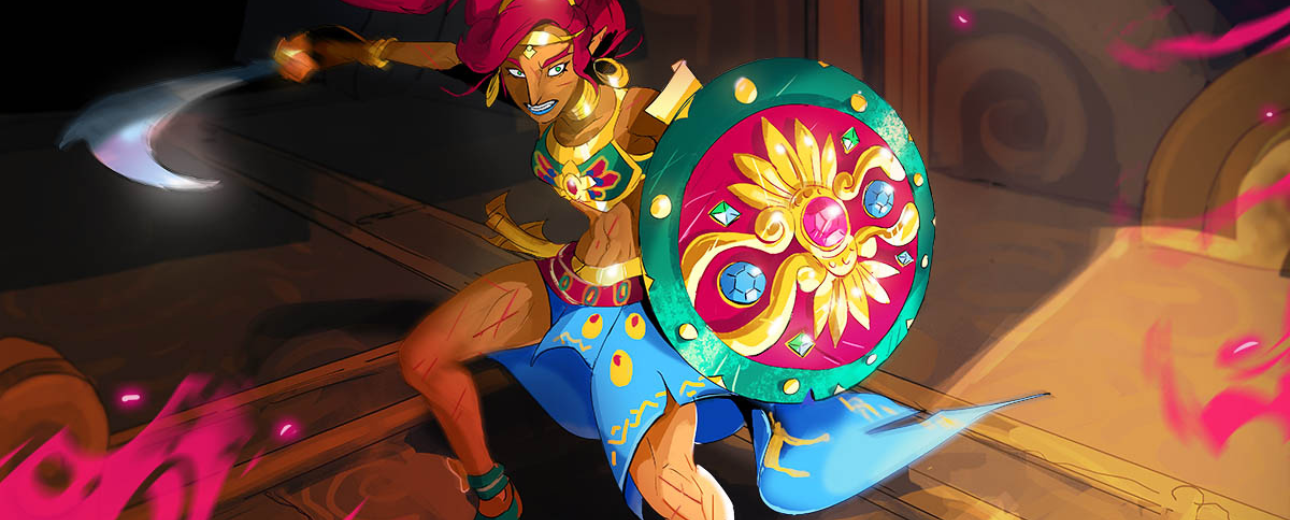
There are characters in video games who are memorable because they are powerful. There are characters who are memorable because they are complex. There are characters who are memorable because they represent something larger than themselves, something that resonates beyond the frame of the screen and into the real experience of the people playing. And then there are rare characters who manage to be all three of these things simultaneously, whose power and complexity and symbolic weight combine into something that feels genuinely irreplaceable. Urbosa is one of those characters.
From the moment she appears in “Breath of the Wild” — striding into frame with the absolute physical confidence of someone who has never doubted her right to take up space, her lightning crackling at her fingertips, her voice carrying the warmth and authority of a person who leads not because she was told to but because she simply is what a leader looks like — Urbosa commands attention in a way that few characters in the Zelda series have ever managed. She is the Gerudo Champion, the pilot of the Divine Beast Vah Naboris, and one of the most beloved supporting characters in a franchise that has been producing beloved characters for nearly four decades.
This guide is the complete Urbosa experience: her biography, her role in “Breath of the Wild’s” story, her relationship with Princess Zelda, her combat abilities and the mechanics of Urbosa’s Fury, her visual design and what it communicates, her presence in the game’s memories, her legacy in “Tears of the Kingdom,” and why she has earned her place as one of the greatest characters Nintendo has ever created. Whether you fell in love with her on your first playthrough or you’re just discovering what makes her so extraordinary, this is everything. Let’s begin.
Who Is Urbosa? A Character Introduction
Before we go deep on any specific aspect of Urbosa’s story, let’s establish who she is in the most complete sense, because she is a character whose full significance only becomes apparent when you see all the different dimensions of her characterization working together. Urbosa is the chief of the Gerudo people at the time of the Great Calamity, roughly one hundred years before the events of “Breath of the Wild.” She is a woman of extraordinary physical presence, commanding nearly two meters in height, with the dark bronze skin, amber eyes, and red hair that mark her as Gerudo, but with an authority and a gravity that goes beyond physical distinction. She is someone whose presence changes the atmosphere of any room she enters.
As chief, Urbosa occupies the highest political and social position available to a Gerudo woman — a position that, as we have explored in our broader guide to the Gerudo people, is one of the most demanding leadership roles in all of Hyrule given the specific challenges of governing a people with their particular history and circumstances. She did not inherit this position through accident of birth. She earned it through a combination of combat excellence, political wisdom, and the specific quality of character that the Gerudo people value most: the ability to be absolutely formidable when formidability is required, and absolutely warm when warmth is what the moment calls for.
Her selection as the Gerudo Champion — one of the four chosen heroes tasked with piloting the Divine Beasts as part of Hyrule’s strategy against the prophesied return of Calamity Ganon — is the most narratively significant fact about her role in the game’s backstory, but it is far from the most interesting fact about her as a person. The most interesting fact about Urbosa is the fullness of her character: the way she combines the physical and martial excellence of a Gerudo warrior with the emotional intelligence and relational depth of a person who genuinely loves the people in her life and expresses that love without reservation or embarrassment.
Her Visual Design: Reading Urbosa Before She Speaks
One of the greatest achievements of Urbosa’s character design is how much information it communicates before she says a single word. Her armor and clothing combine the desert-adapted practicality of Gerudo fashion with the ornamentation of someone whose social status and personal identity are both expressed through visual means. The gold and teal color scheme that dominates her outfit is visually distinctive and immediately communicates status, but it also has a specific elegance that suggests a person for whom beauty and strength are not in tension but are expressions of the same underlying value.
Her physical build is worth examining in detail because it is an unusually honest piece of character design for a female video game character. Urbosa is genuinely imposing: her height, her musculature, her proportions all communicate someone whose physical capability is real rather than decorative. She does not look like a fighter because the game needs you to believe she is one. She looks like a fighter because she is one, and the design has the integrity to represent that honestly. This physical honesty extends to the way she moves — with the ease and economy of someone to whom physical mastery is so deeply ingrained it has become invisible.
Her facial design is equally communicative. There is a warmth in her expression that is immediately apparent even in her most serious moments, a quality that suggests a person for whom care for others is a fundamental orientation rather than an occasional posture. Her eyes, in particular, are used throughout the game’s memory sequences to convey emotional states with remarkable precision, from the fierce pride she shows during combat to the tender protectiveness she demonstrates in her interactions with Zelda.
Urbosa’s Voice and Performance
The English voice performance of Urbosa by Elizabeth Maxwell is one of the most significant contributions to the character’s impact, and it deserves explicit recognition. Maxwell’s vocal work gives Urbosa a specific quality that is almost impossible to describe precisely but immediately recognizable: a voice that is simultaneously warm and authoritative, that can express affection and command in the same breath without either feeling diminished by the other. It is a voice that sounds like it belongs to someone who has been listened to for a long time and who has used that attention responsibly.
The specific choices Maxwell makes with Urbosa’s speech patterns — the measured pacing, the precise emphasis, the way warmth breaks through even in moments of formal authority — create a character whose presence on the soundtrack is as distinctive as her presence on the screen. Many players report that Urbosa’s voice is one of the first things they think of when her name is mentioned, which is the mark of a performance that has fused completely with the character rather than simply serving it.
Urbosa’s Role in the Great Calamity: Historical Context
To understand Urbosa’s full significance, you need to understand the historical moment she inhabited, because the Great Calamity and the years leading up to it were one of the most consequential periods in Hyrulean history, and Urbosa’s choices during that period had effects that echo through the entire narrative of “Breath of the Wild.” The world she lived in was one of prophecy and urgency, of a kingdom mobilizing its resources against a threat that was both certain and undefined, and of individuals being asked to commit their lives and abilities to a cause whose ultimate outcome they could not know.
The years before the Calamity were, from the perspective of Hyrule’s political leadership, a race against time. The ancient Sheikah prophecy had foretold the return of Calamity Ganon, and the discovery of the four Divine Beasts and the Guardian weapons offered what seemed like a genuine strategic advantage — if the right pilots could be found and trained in time. King Rhoam’s plan to recruit the finest warriors of each people as Champions was both militarily sound and politically complex, requiring the cooperation of leaders who had their own people’s interests to balance against the needs of the larger kingdom.
Why Urbosa Agreed to Be Champion
The question of why Urbosa agreed to become the Gerudo Champion is one of the most interesting in the game’s backstory, and the memory sequences give you enough information to construct a nuanced answer that goes well beyond simple loyalty to Hyrule or simple ambition for glory. Her motivations are multiple and interlocking, and understanding them helps you understand who she is at the deepest level.
The first and most straightforward motivation is hatred of Ganon. Urbosa’s specific hostility toward Calamity Ganon is not generic villain-hatred but something more personal and more culturally specific. As a Gerudo leader, she carries the weight of her people’s complicated relationship with their most famous member, the man whose periodic reincarnation as the embodiment of evil has cast a shadow over Gerudo history across generations. When Urbosa expresses disgust at Ganon’s Gerudo origin, she is expressing not just her own feelings but a collective Gerudo shame that she has clearly internalized and made personal. Becoming Champion is, in part, an act of atonement on behalf of her people — a statement that the Gerudo will not simply produce the great evil but will actively work to defeat it.
The second motivation is her relationship with Zelda’s mother, which is referenced in the memory sequences as a deep personal bond that preceded the events of the game by a significant period. Urbosa’s devotion to Zelda is presented as a continuation and extension of this earlier relationship — she loves Zelda because she loved Zelda’s mother, and she sees her commitment to helping Zelda fulfill her destiny as an expression of that earlier loyalty. This personal dimension of her motivation distinguishes her from Champions who are primarily motivated by duty or by the challenge itself.
The third motivation is strategic wisdom. Urbosa is a political leader of long experience, and she can read the situation clearly: the Calamity is coming, and Hyrule’s best chance of surviving it requires the active participation of all its peoples’ finest warriors. Refusing to participate would not protect the Gerudo from the Calamity’s consequences — it would simply ensure that Hyrule faced those consequences with fewer resources. Urbosa’s decision to become Champion is, among other things, the decision of a pragmatic leader who understands that isolation is not a viable response to an existential threat.
The Champions and Their Relationships
Urbosa’s relationships with the other Champions — Revali, Daruk, Mipha, and Link — are sketched with enough specificity in the memory sequences to create a convincing picture of a group of extraordinary people who were brought together by circumstance and who formed genuine bonds despite their differences. These relationships are worth examining because they illuminate different aspects of Urbosa’s character through the contrast and complement of different personalities.
Her relationship with Revali is perhaps the most delightfully textured, because they share enough personality traits — pride in their exceptional abilities, directness in expressing their assessments, a certain impatience with those who don’t meet their standards — that their interactions have the quality of two strong personalities who respect each other precisely because they recognize themselves in the other. Urbosa never takes Revali’s condescension toward Link at face value; she challenges it with the specific confidence of someone who has her own assessment of Link’s qualities and doesn’t feel the need to defer to Revali’s.
Her relationship with Mipha is the warmest among the non-Zelda Champions, with the gentleness and emotional openness of the young Zora princess clearly appealing to the protective, nurturing dimension of Urbosa’s character. Where Urbosa treats Revali as an equal who needs to be challenged, she treats Mipha with the affectionate protectiveness she reserves for those she considers genuinely precious. Their dynamic is one of the most touching in the memories, a friendship between two very different women that is united by genuine care and genuine respect.
Urbosa and Princess Zelda: The Most Important Relationship in BotW
If you had to identify the single most important relationship in “Breath of the Wild’s” backstory — not the most central to the game’s mechanics or its main narrative, but the most emotionally significant, the one that adds the most depth and resonance to everything that happened a hundred years before Link woke up in the Shrine of Resurrection — it would have to be Urbosa and Zelda. This relationship is the emotional heart of the game’s memory sequences, and understanding it fully transforms your experience of the game’s melancholy and its ultimate message of hope.
Zelda at the time of the Calamity is one of the most sympathetically portrayed characters in the Zelda series: a young woman of genuine intelligence, deep commitment, and extraordinary burden, struggling under the weight of a destiny she cannot seem to access, a father whose love expresses itself as pressure and disappointment, and a world that is counting on her without giving her the tools she needs. She is, in many ways, profoundly alone in the middle of being surrounded by people who care about her — alone because the specific nature of her struggle with the sealing power is something no one else can share or fully understand.
Except Urbosa. Not because Urbosa shares Zelda’s specific struggle — she doesn’t, she has her own relationship with power that is very different — but because Urbosa is the one person in Zelda’s life who is willing to simply be present with her difficulty without trying to solve it, who can hold space for Zelda’s pain and uncertainty without immediately redirecting toward solutions or reassurances. This is a specific and rare form of care, and it is what Zelda needs most desperately and receives most rarely from the other people in her life.
The Memory Sequences: Every Urbosa-Zelda Moment Analyzed
The memory sequences in “Breath of the Wild” are one of the game’s most sophisticated narrative devices, delivering the game’s primary backstory in fragments that require the player to actively seek them out, creating a relationship between the player’s engagement and the story’s revelation that mirrors Link’s own process of recovering his memories. The memories involving Urbosa and Zelda are among the most carefully crafted in the entire sequence, and they reward close attention.
The memory showing Urbosa comforting Zelda after a particularly difficult encounter with her father is the sequence that most clearly establishes the nature of their relationship. Zelda is visibly distressed, struggling with the combination of her inability to access her power and her father’s inability to see beyond her failure to do so. Urbosa’s response is not to minimize the pain or to offer strategic advice. It is to be physically and emotionally present, to acknowledge the difficulty, and to remind Zelda of her own worth independent of her success or failure at the task she has been assigned. This is the behavior of a person who genuinely loves someone, not of a mentor or an ally performing emotional support as a strategic function.
The memory of Urbosa watching Zelda pray at one of Hyrule’s sacred springs is another beautifully observed moment, capturing something true about the specific texture of care: the way people who love each other watch each other when they think they’re not being watched, with an unguarded tenderness that would embarrass both parties if acknowledged directly. Urbosa’s expression in this memory is one of the most emotionally complex in the entire game, combining fierce pride, deep affection, and a grief that is clearly anticipatory — she knows what is coming, and she is already mourning it.
What Urbosa Represents to Zelda
The significance of Urbosa in Zelda’s life goes beyond their individual relationship and touches on something more structural about what Zelda lacks and needs. Zelda is surrounded by people who relate to her primarily through the lens of her destiny and her power: her father sees her as the vessel of sealing power that the kingdom needs; Link is present as the partner that her destiny requires; the other Champions, however well-intentioned, are connected to her through the shared project of preparing for the Calamity.
Urbosa is different. She relates to Zelda as a person first, as a young woman she genuinely likes and admires independent of what she can do or what she represents. The conversations they have in the memories are not primarily about the Calamity or about Zelda’s power — they are about Zelda herself, her thoughts and feelings and fears, her relationship with her mother’s memory, her sense of herself as distinct from the role she is expected to fill. Urbosa creates space for Zelda to be a person rather than a prophecy, and that space is one of the most precious gifts she could have given.
This quality in Urbosa’s relationship with Zelda also illuminates something important about Urbosa’s leadership style more broadly. The capacity to see individuals as individuals rather than as functions — to engage with who people are rather than what they do — is one of the rarest and most valuable qualities in any leader, and it is one that Urbosa demonstrates consistently in her interactions throughout the memory sequences.
Urbosa’s Combat Abilities: Power of Lightning and Naboris
Urbosa is, within the Zelda universe’s power hierarchy, one of the most formidable non-supernatural fighters in the franchise. Her combat abilities combine physical excellence with the extraordinary elemental power of lightning that she has developed and mastered over a lifetime of training, creating a fighting style that is as distinctive as her personality and as effective as her reputation suggests. Understanding her combat capabilities helps you appreciate both her selection as Champion and the scale of what was lost when Vah Naboris fell to Thunderblight Ganon.
The foundation of Urbosa’s fighting style is the scimitar, the traditional Gerudo weapon that she handles with a mastery born of decades of practice. Her swordsmanship is the baseline that her lightning powers augment rather than replace — she is a formidable fighter without the lightning, and adding it creates a combination that most opponents have no framework for dealing with. The integration of her electrical abilities into her melee combat is seamless and clearly the product of extensive practice: she doesn’t use lightning as a separate attack mode but as a continuous enhancement of her physical fighting style, charging her blade and her body to add electrical damage to every strike.
Urbosa’s Fury: The Champion Ability Explained
Urbosa’s Fury is the Champion ability that Link receives after defeating Thunderblight Ganon and freeing Urbosa’s spirit from Vah Naboris, and it is one of the most satisfying and most visually spectacular abilities in “Breath of the Wild.” The ability allows Link to charge his weapon strikes with electrical energy, releasing a powerful lightning strike that damages all enemies in the surrounding area. It can be charged through held attacks and releases with a visual effect that mirrors Urbosa’s own lightning, creating a direct experiential connection between the player and the Champion who granted the ability.
The mechanics of Urbosa’s Fury are straightforward but satisfying in their simplicity: hold a weapon strike to build charge, release to trigger the lightning, deal significant damage to everything in range. The three-charge version of the ability, available after the lightning strikes have regenerated, releases a particularly devastating attack that can clear groups of enemies efficiently and is one of the most useful tools in difficult combat encounters. The visual and audio design of the ability is exceptional, with the crackling electricity and the thunderclap of the strike creating an experience that feels genuinely powerful rather than just mechanically effective.
The ability’s design also reflects something meaningful about the relationship between Link and Urbosa: it is not simply a power transfer but a continuation of Urbosa’s own fighting style, a way of carrying something of her into combat situations that she can no longer participate in directly. This emotional dimension of the Champion abilities is consistent across all four of them, but Urbosa’s Fury is perhaps the most viscerally satisfying precisely because of how closely it mirrors what we see Urbosa herself doing in the memory sequences.
The Divine Beast Vah Naboris: Urbosa’s Domain
Divine Beast Vah Naboris is the mechanical construct that Urbosa piloted as Champion, and it is one of the most visually spectacular of the four Divine Beasts in “Breath of the Wild.” Its camel-like design, adapted for the desert environment of the Gerudo region, is simultaneously alien and elegant, and its electrical storm generation capability — which it uses to deter anyone from approaching during the game’s present timeline — is a direct expression of Urbosa’s own elemental affinity, as if the machine has taken on something of its pilot’s character even in her absence.
The dungeon interior of Vah Naboris is built around electrical puzzles that require the player to manipulate the flow of electricity through the Divine Beast’s systems to activate terminals and unlock access to the boss chamber. The puzzle design is consistently clever and environmentally coherent — everything inside Naboris relates to electricity in some way, creating a dungeon that feels thematically unified rather than mechanically arbitrary. The rotating cylindrical sections that form the dungeon’s core mechanical system are particularly inspired, creating a puzzle environment that is genuinely three-dimensional in its solutions.
Thunderblight Ganon: The Battle That Took Urbosa
Thunderblight Ganon is the Blight that possessed Divine Beast Vah Naboris and killed Urbosa, and confronting it is the culminating event of the Vah Naboris quest chain. It is, fittingly, one of the most challenging of the four Blight boss fights, with a speed and aggressiveness that matches what you might expect from a Blight designed to counter the specific capabilities of its host Champion. The fight is demanding and requires genuine engagement with its mechanics, which is appropriate given the emotional weight of what is at stake.
The fight proceeds in two distinct phases. In the first phase, Thunderblight Ganon attacks with a combination of rapid sword strikes and electrical projectiles, moving so quickly that standard dodge timing needs to be precisely calibrated. The key to this phase is learning the rhythm of its attack patterns — it is fast but not random, and once you identify the windows between its attack sequences, landing significant damage becomes manageable. Urbosa’s Fury, if you’re replaying the dungeon with the ability already acquired, is particularly satisfying to use in this fight given the thematic appropriateness of using Urbosa’s own lightning against the thing that killed her.
Phase Two and the Electrified Pillars Mechanic
The second phase of the Thunderblight Ganon fight introduces the game’s most creative Blight mechanic: the boss drops large metallic pillars from the ceiling, which it then electrifies, creating a hazardous environment that forces you to rethink your use of the space. The intended solution involves using Magnesis to lift one of the metallic pillars and throw it at the electrified Thunderblight Ganon, using the boss’s own electrical charge against it to stun it and create a damage window.
This mechanic is one of the most satisfying puzzle-fight intersections in the entire game, requiring you to use a standard dungeon tool — Magnesis — in a combat context in a way that is both logical and clever. The moment of recognition when you realize what the pillars are for is one of those genuinely delightful “of course” moments that the best Zelda design consistently produces, and the execution of the solution — lifting a massive metal column with magnetic power and flinging it at a supernatural monster — is appropriately spectacular.
After defeating Thunderblight Ganon, Urbosa’s spirit is freed and she speaks to Link in one of the most emotionally resonant post-boss sequences in the game. Her words are characteristically direct and warm: gratitude for the liberation, an expression of her ongoing care for Zelda, and the granting of her Fury as a gift for the battles ahead. Even in this moment of her freedom from a hundred years of captivity, her thoughts are primarily for Zelda rather than for herself, which is perfectly consistent with everything the memory sequences have shown us about her character.
Urbosa’s Death and Legacy: What She Left Behind
The death of Urbosa — the moment when Thunderblight Ganon overwhelmed her and seized control of Vah Naboris — is one of the Great Calamity’s most significant individual tragedies, and while “Breath of the Wild” doesn’t depict it directly, it is present throughout the game as a weight, a loss that shapes the world Link wakes up into in ways both visible and invisible. Understanding what Urbosa left behind, what her legacy means for the Gerudo people and for Zelda, is essential to fully appreciating her character.
The most immediate legacy is Riju, the young Gerudo chief who leads her people in the game’s present timeline. The connection between Urbosa and Riju is explicitly established in the game: Riju is Urbosa’s descendant, carrying on the leadership tradition that Urbosa represented in her own time. Watching Riju — young, somewhat uncertain of her authority, but clearly in possession of genuine capability and genuine character — you can see both the echo of Urbosa’s qualities and the specific way that one hundred years without Urbosa’s direct influence has changed the Gerudo leadership.
Urbosa’s Scimitar and Shield: The Physical Legacy
Urbosa’s Scimitar of the Seven and Daybreaker shield are the physical artifacts that connect the present to her memory, and recovering or reforging them is one of the game’s most meaningful side quest rewards. The weapons are exceptionally powerful by game standards, but their significance goes beyond their mechanical usefulness: they are the weapons that Urbosa herself carried into battle, the tools of her specific fighting style, and holding them creates a direct tactile connection to the woman who used them.
The quest to reforge these weapons after they degrade, which involves gathering specific materials and returning to the Gerudo smiths who maintain the knowledge of their construction, is one of the game’s most satisfying completionist activities. The effort required is proportional to the significance of the items, and the result — having Urbosa’s own weapons in Link’s arsenal — feels appropriately ceremonial, like carrying a piece of her history into the battles that her death made necessary.
How Urbosa’s Memory Shapes the Present
The way that Urbosa’s memory operates in the present timeline of “Breath of the Wild” is one of the game’s most sophisticated narrative achievements. She is absent — dead for a hundred years — but her presence is felt in multiple ways throughout the Gerudo questline: in Riju’s leadership, in the Gerudo’s relationship to Vah Naboris, in the specific quality of respect and grief that older Gerudo characters express when her name comes up. She has become, in the century of her absence, something close to a founding myth — a standard against which current Gerudo leadership is implicitly measured and always, to some extent, found wanting simply because she was genuinely exceptional.
This is the specific legacy of truly great leaders: they do not simply accomplish things during their lifetimes. They set standards that persist after them, that shape what their communities expect and aspire to in the leaders who follow. Urbosa’s legacy among the Gerudo is this kind of standard-setting legacy, and recognizing it helps you understand both why Riju is the specific person she is and why the Gerudo response to Vah Naboris’s liberation is so emotionally charged.
Urbosa in Tears of the Kingdom: Continuity and Change
“Tears of the Kingdom” does not bring Urbosa back — her spirit was freed and she passed on at the end of “Breath of the Wild,” and the newer game respects that conclusion rather than undoing it. But Urbosa’s presence in “Tears of the Kingdom” is felt in multiple ways that reward attention from fans who care about her legacy.
The most direct continuity is through Riju, who returns in “Tears of the Kingdom” as a more mature and more assured leader than the young chief we met in “Breath of the Wild.” Riju’s growth between the two games is one of the most satisfying character arcs in the sequel, and watching her operate with the combination of authority and warmth that characterizes Urbosa’s legacy is one of the quiet pleasures of the Gerudo questline in the newer game. She is not Urbosa — she is her own person, with her own specific qualities and her own approach to leadership — but the inheritance is visible, and it is handled with care.
Riju as Urbosa’s True Legacy
Riju’s arc in “Tears of the Kingdom” is the fullest expression of what Urbosa’s legacy means in practice. The young chief who was struggling with the weight of an authority she hadn’t fully grown into has become a woman who carries that authority with evident comfort, who leads her people through a new crisis with the combination of practical competence and genuine care for individuals that Urbosa herself demonstrated. The specific qualities that made Urbosa exceptional — the directness, the warmth, the refusal to let protocol override human connection — are present in Riju in recognizably descended form.
The Lightning Helm that plays a crucial role in Riju’s Champion power in “Tears of the Kingdom” creates another explicit connection to Urbosa, linking the younger leader’s specific combat capability to the elemental legacy of her ancestor. When Riju calls down lightning as part of her Champion ability, she is doing something that Urbosa did — not in the same way, not with the same instinctive mastery, but in a form that clearly descends from the same tradition. This physical inheritance of elemental capability is one of the game’s most meaningful expressions of how legacy actually works: not as exact replication but as descended and transformed continuation.
Why Urbosa Resonates: Cultural Significance and Fan Response
The fan response to Urbosa has been extraordinary from the moment “Breath of the Wild” was released, and understanding why she resonates so deeply with so many players requires looking at what she represents beyond the specifics of her story. She is, in many ways, a character that the Zelda series — and video games more broadly — had been building toward for a long time: a female character who is fully adult, fully powerful, fully warm, and fully present as an individual rather than as a function in someone else’s narrative.
The significance of her being fully adult is something that deserves specific attention. The Legend of Zelda series has historically tended toward young protagonists and young supporting characters, which reflects the series’ target audience but also, inadvertently, limits the range of female characters it can meaningfully represent. Zelda herself is typically a young woman; Mipha in “Breath of the Wild” is young; even Saria and most other significant female characters in the series tend toward youth. Urbosa is different: she is clearly middle-aged or older, a woman who has lived significantly and who carries that experience with her. This is unusual enough in video games generally, and specifically in Zelda, that it reads as a meaningful creative choice.
Representation and What Urbosa Means to Fans
The specific combination of qualities that Urbosa embodies — physical power, emotional intelligence, genuine warmth, unflinching directness, mature authority — represents something that many players, particularly women and girls, report having rarely encountered in video game characters. The reaction to her in fan communities has been remarkable in its intensity and in the specific terms in which fans describe her significance: many players have written and spoken about Urbosa as a character who made them feel seen in ways that gaming had rarely managed before.
This response is not incidental to her design. It reflects real creative decisions made by the team at Nintendo: the decision to make her physically imposing rather than conventionally pretty-but-small, the decision to give her a maternal relationship with Zelda that is warm and genuine rather than professional, the decision to make her the most politically powerful of the Champions in her own community, the decision to give her a death that is mourned as a genuine loss rather than used purely as narrative fuel. These decisions add up to a character who feels real in a way that reflects genuine respect for the audience that will respond to her.
Urbosa in Fan Creative Work
The volume and quality of fan creative work centered on Urbosa is one of the clearest measures of her impact. Fan art, fan fiction, cosplay, musical tributes, analytical essays — the Urbosa fan creative community is one of the most active and most thoughtful in the broader Zelda fandom, and the work it produces consistently engages with the character’s full complexity rather than reducing her to a single quality or a single moment.
The cosplay community has embraced Urbosa with particular enthusiasm, and the challenge of recreating her distinctive armor and physical presence has inspired some of the most ambitious Zelda cosplay work in recent years. The technical demands of accurately representing her gold-and-teal color scheme, her jewelry, and the specific quality of her physical presence have pushed cosplayers to develop innovative construction techniques, and the results are consistently spectacular.
The Music of Urbosa and Vah Naboris: An Underappreciated Score
No complete guide to Urbosa would be complete without addressing the music associated with her and Vah Naboris, because the score is one of the most sophisticated and most emotionally intelligent in “Breath of the Wild’s” already excellent soundtrack. The themes associated with the Gerudo region, Vah Naboris, and the Thunderblight Ganon battle all carry a specific musical character that reflects and enhances the emotional content of Urbosa’s story.
The Gerudo Town theme from “Breath of the Wild” is built on a foundation of exotic-sounding percussion and melodic elements that evoke the desert environment and the specific cultural identity of the Gerudo people. It is warmer and more festive than you might expect from a region associated with danger and power, which reflects accurately the hospitality and community warmth of the Gerudo city even in difficult times. Hearing this music while exploring the city creates a specific emotional atmosphere that makes the quest’s eventual darker turns more affecting by contrast.
The Vah Naboris dungeon music takes a very different approach, with a more electronic, synthesized texture that reflects the mechanical nature of the Divine Beasts and the electrical theme of this specific dungeon. The music evolves as you progress through the dungeon, building tension as you approach the boss chamber in a way that is subtle but effective. The Thunderblight Ganon battle music is appropriately intense and electric, with a propulsive energy that matches the speed and aggression of the boss fight itself.
The Memory Music and Its Emotional Function
The music that accompanies the memory sequences involving Urbosa deserves particular attention because of how effectively it supports the emotional content of those scenes. The memory music in “Breath of the Wild” uses a piano-led orchestral style that is consistently more intimate than the main game’s score, creating an emotional register appropriate to the personal, retrospective quality of the memories themselves.
The memories involving Urbosa and Zelda use this intimate musical style to particularly good effect, with the specific harmonic choices in those sequences carrying an emotional weight that adds significantly to the impact of the dialogue and performances. The music in the memory showing Urbosa comforting Zelda, for instance, has a specific gentle quality that would be maudlin in a lesser context but that here simply enhances the genuine tenderness of the scene. This is film-score quality emotional support, and its presence in a video game context reflects the creative ambition of “Breath of the Wild’s” entire approach to narrative.
Urbosa’s Place in Zelda History: The Lasting Legacy
As we approach the conclusion of this guide, it’s worth stepping back from the specific details and asking the larger question: where does Urbosa stand in the history of the Zelda franchise, and what does her presence in it mean for the series going forward?
The answer, I think, is that Urbosa represents a genuine expansion of what the Zelda series can be and do as a vehicle for character-driven storytelling. The franchise has always had memorable characters, but they have historically been memorable in specific and somewhat limited ways: memorable for their role in the mythology, memorable for a specific moment or ability, memorable for a distinctive visual design. Urbosa is memorable in all of these ways but also in a way that goes deeper: she is memorable as a person, as a specific individual whose combination of qualities creates something that feels genuinely irreplaceable.
What Urbosa Teaches the Zelda Series About Character
The creative success of Urbosa demonstrates several things about character design that the Zelda series has taken on board in subsequent games. The “Tears of the Kingdom” treatment of both Riju and the new Champions shows clear learning from what made Urbosa work: the attention to individual personality, the willingness to give characters emotional lives that extend beyond their narrative function, the specific care with which relationships between characters are constructed and depicted.
Riju’s development between “Breath of the Wild” and “Tears of the Kingdom” is perhaps the clearest example of this inherited wisdom: she is treated as a full person whose growth matters, whose specific qualities are worth exploring, and whose relationship to Urbosa’s legacy is handled with the same kind of emotional intelligence that characterized the original relationship between Urbosa and Zelda. This continuity of care across two games is a meaningful statement about how Nintendo has internalized what made Urbosa so effective.
The Standard Urbosa Sets for Future Zelda Characters
Urbosa has set a standard for female characters in the Zelda series that is both inspiring and demanding: inspiring because she demonstrates that the series is capable of creating female characters of genuine complexity and genuine power, demanding because any subsequent female character of similar prominence will inevitably be measured against what she achieved. This is a positive creative pressure, the kind that pushes a franchise toward greater ambition and greater care in its character work.
For fans who engage deeply with the Zelda universe, Urbosa has also demonstrated the specific value of supporting characters who are fully realized as individuals: the way that depth in secondary characters enriches the entire world they inhabit, making that world feel more real and more worth caring about. The emotional weight that the Great Calamity carries in “Breath of the Wild” is substantially a product of having characters like Urbosa — people whose loss you actually feel rather than simply register — at the center of its backstory.
She is the chief, the Champion, the lightning-wielder, and Zelda’s most beloved companion. She is fierce and she is tender. She is the greatest Gerudo of her generation and the person who saw Zelda most clearly when everyone else was looking at the prophecy. She is, in every sense that matters, one of the greatest characters Nintendo has ever created, and this guide has been an act of celebration of everything she is and everything she means.
For readers who want to explore Urbosa further, the official Zelda Wiki at zeldawiki.wiki maintains comprehensive documentation of her history, abilities, and appearances across both games. The Zelda Dungeon at zeldadungeon.net provides detailed walkthroughs of the Vah Naboris dungeon and the Thunderblight Ganon fight for players who want mechanical guidance. “Breath of the Wild” and “Tears of the Kingdom” are both available on Nintendo Switch and remain the essential experiences — no guide can fully substitute for spending time with Urbosa in her own world. And the Art of Breath of the Wild book, published by Dark Horse and available at www.darkhorse.com, contains extraordinary concept art and development notes that reveal the creative thinking behind Urbosa’s design in fascinating detail.
May Urbosa’s Fury strike true.